
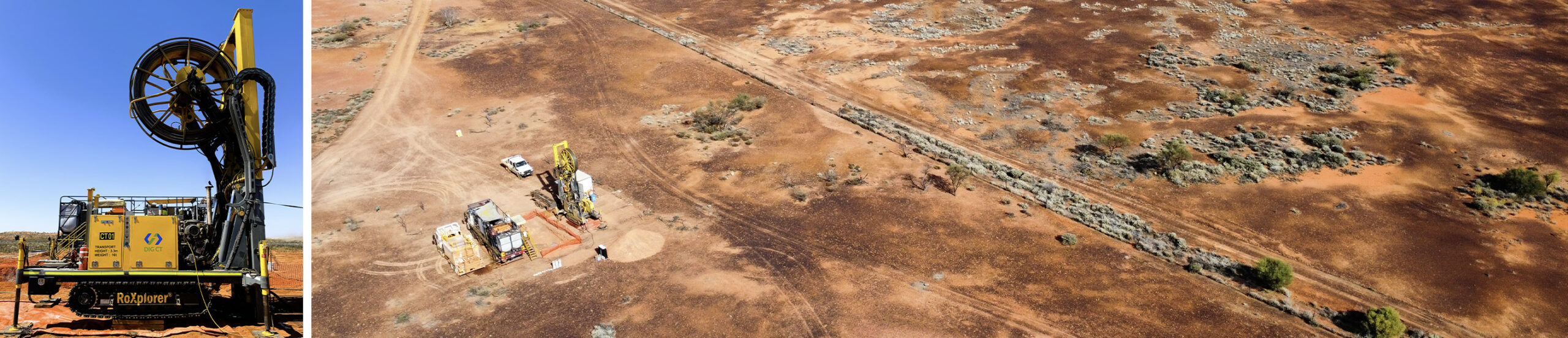
CT Drilling Advantages – Working to a Greener Future
When compared to a conventional diamond drill hole to a depth of 500m, CT-style drilling results in:
- 0 HSEC-related incidents (after drilling 21,000m)
- 86% fluid (water) reduction
- 80% less consumable usage
- 57% cost reduction
- 80% carbon emission reduction
- Excellent sample quality
= A PATH TO NET ZERO
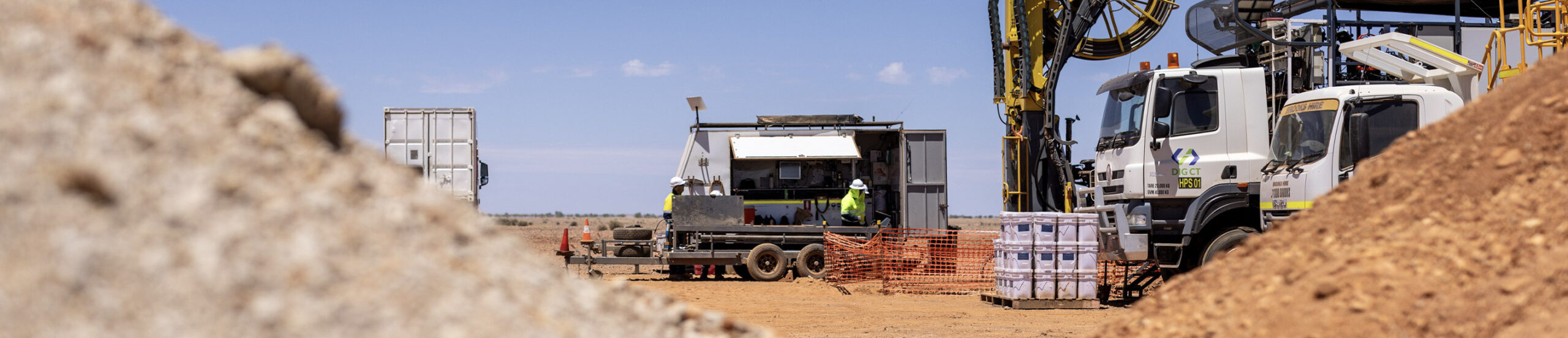
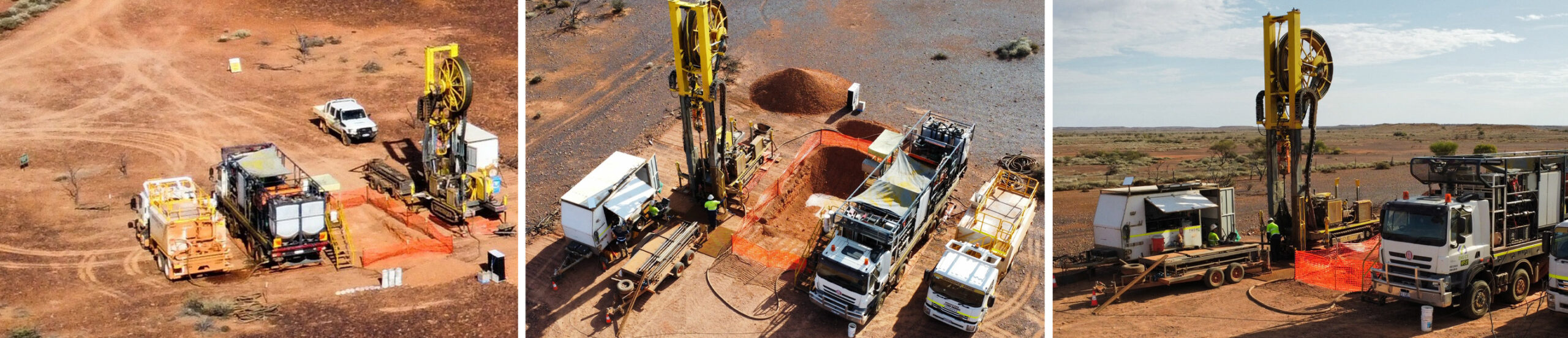
Coiled tubing (CT) drilling isn’t new and was adopted by the oil and gas industry in the sixties (1960s), mainly across large-bore deep drilling for petroleum. It is however ‘novel’ to mineral exploration – an industry not so keen to adopt until it has to.
CT drilling offers many benefits and efficiencies:
- faster penetration
- reduced operational hazards for drill crew
- lower fuel use
- reduced environmental footprint (less surface area, water, muds and consumables)
- mobility and agility – CT rigs mobilise and demobilise fast!
- ability to angle or wedge drill at *almost* every angle to horizonal
DIG CT’s prototype CT500 drilling rig is a portable, low-footprint system suited for mineral exploration drilling and capable of penetrating to 500m depth, while the second-generation rig has been redesigned to drill beyond 1200 metres particularly in resource-rich Western Australia where many mineral exploration targets are deeply embedded.
Depending on site set up, CT drilling can be up to five (5) times cheaper than conventional diamond drilling.
Although heavily adopted across the oil and gas industry, CT drilling has been proven to be just as efficient in mineral exploration, geothermal, coalbed methane, well logging and workover operations.
Pad size: Mast angle doesn’t affect pad size which is 20 x 20 m (65ft x 65ft).
RoXplorer® CT500 Rig Dimensions:
- Length: 8.3 m or 27.2 ft
- Width 2.5 m or 8.2 ft
- Height (mast down): 3.3 m or 10.8 ft
- Weight: 16 tons or 32000 lbs

Fluid Processing System (FPS) Dimensions:
- Length: 11.3 m or 37.1 ft
- Width: 2.5 m or 8.2 ft
- Height 4.3 m or 14.1 ft
- Weight (empty): 23 tons or 46000 lbs
1.5 to 2 hours (down and up).
Depends on distance between drill pads with the option to tram rig or transport on a low loader truck.

Currently, the CT500 rig must be ‘floated’ as it is on tracks, however, the rig can tram at 7mph if required. All other equipment is mobile yet to Australian driving standards (steering wheel is on the right-hand side).

Two to three crew. At a minimum, two crew – Driller and Drill Assistant plus a Supervisor, if necessary.
Training aligns and is similar in safety, environmental and site compliance, however a key differentiator is DIG CT’s alliance with University of South Australia (UniSA) with the creation of a digital twin which involves a virtual reality rig to assist in familiarising and training new/prospective drillers in a classroom environment, particularly with Drill Helpers allowing them to walk around a drill site looking for hazards and completing work procedures etc. online/digitally rather than risk physical safety as is common when training in the field, as well as eliminate logistical and budgetary constraints (transport, PPE and lodging) at remote locations. Real data allows for simulation and assessment of downhole issues.
(Note: the digital twin has the potential to allow autonomous control of the rig which may prove lifesaving in an emergency event).
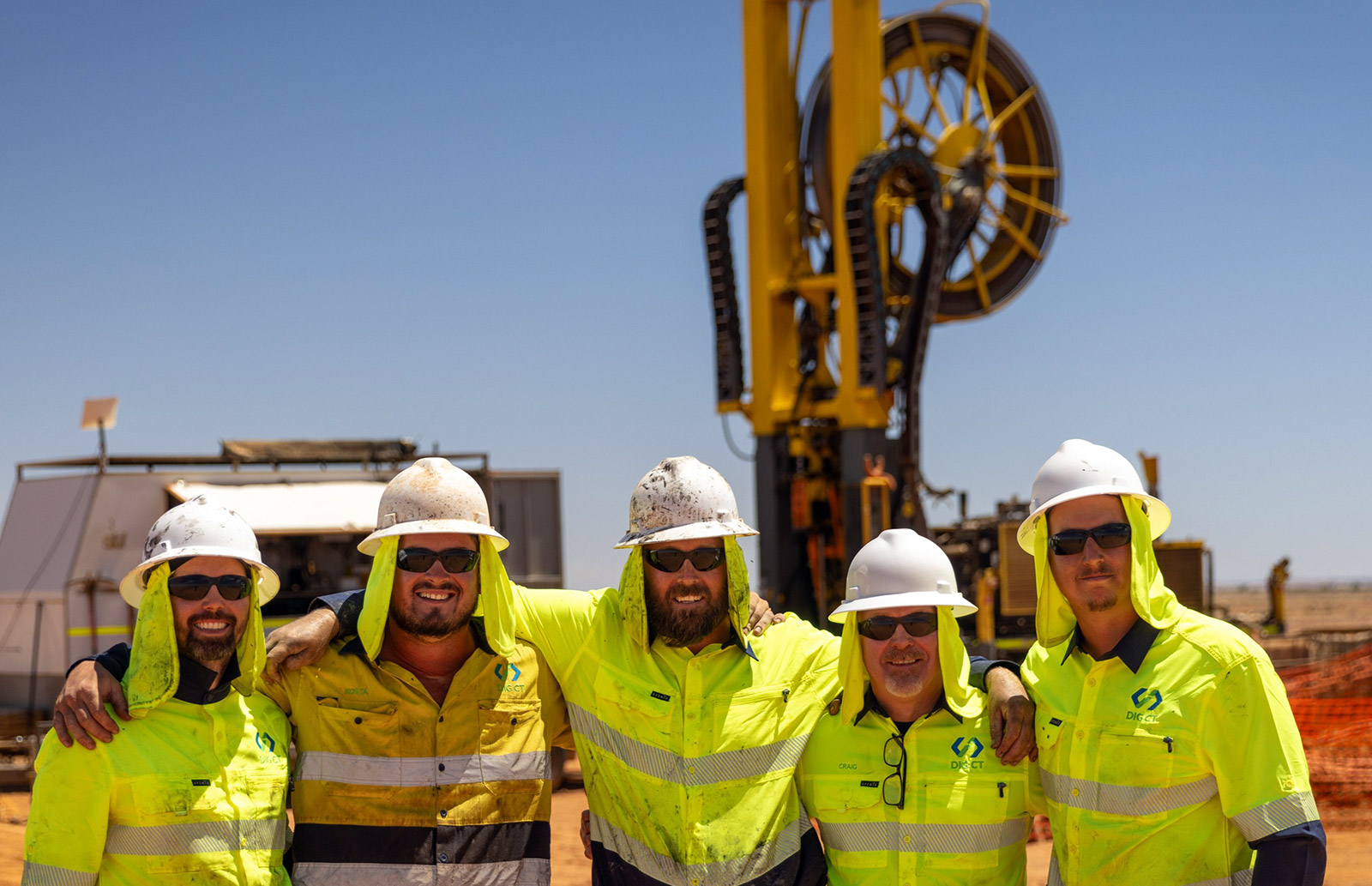
The CT rig has a 500m (1640 ft) coil of malleable steel on a reel attached to the mast replacing the need for drill pipe. The steel coil advances down the drill hole with a Bottom Hole Assembly (BHA) and drilling tools to reach the required depth.
Remove the coil from the hole and change the desired bit size. Currently, it is a manual procedure which will be eliminated with the new design.
- PDC (polycrystalline diamond compact/composite)
- hammer percussive
- and diamond drill bits.
If fluid return is lost, the sample return is also lost from the PDC, and hammer for it is an annular sample. The driller can change to diamond core to regain the sample if required. The organic and proprietary drilling consumable ‘Ctrol’ DIG CT utilises assists with conditioning and stabilising the drill hole. (A definitive feature of CT drilling is its continuous flow which minimises damage to drill holes and assists with stabilisation and sealing the drill hole from contamination).
Currently the maximum is 60m HWT and 200m HQ.
Depending on application, size, and/or depth (not for the coil; for the casing).
Yes, although a hammer would need to be applied.
Remove the PDC bit and run down with hammer if needed before changing back to PDC to continue if in unconsolidated material (versatility is one of CT drilling’s many features).
- Hammer: 15m to 20m per hour
- Core: 3m per hour
500m or 1640 feet.
- Diamond Coring: LTK60 hole size: 59.8mm Core size: 44mm.
- PDC and Hammer: sizes range from 82mm to 96mm.
- Top Hole: 6 inches to 60 metres.
All cementing is completed through the coil. On average, it takes three (3) hours to reach 500m (1640 feet) which is to complete ‘bottoms up’ (cementing and abandonment). This process is much safer and more efficient/productive than conventional drilling.
Available online anytime and anywhere showcasing the rig in operation including all drilling metrics, the fluid system and fluid system control. (A Fluid Engineer can manipulate fluid control remotely if required).
Similar to wireline surveys yet attached to the end of a coil. The gyro and gamma survey tool can be run in any section of a drill hole, and incrementally (meterage or footage) while drilling and when completing end of hole surveys.
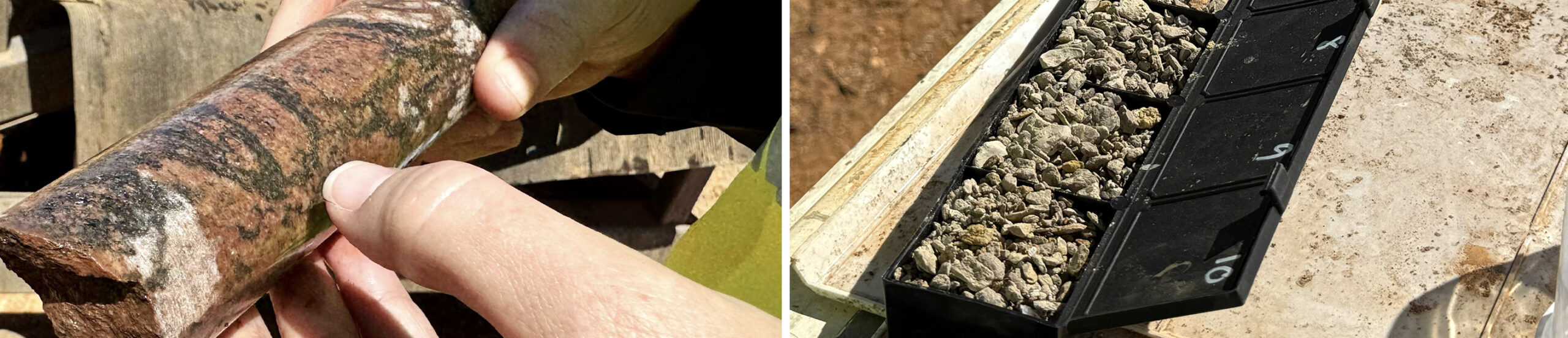
Typically, 2mm to 3mm with hammer, 3mm to 5mm with PDC.
They’re collected or discarded pending client request using a shaker screening process, changing the filter or screen micron to requested sample sizing.
By coring through a core barrel assembly. The chip sampling diverts or is routed over the top of the shaker screens into calico sample bags for collection and can vary in size from a five (5) to eight (8) kilogram single bag (between 11 and 17.5 lbs.) for a one (1) metre (3.28 ft) sample depending on client requests. Conversely, client sample requests can be as small or low as a 20cm (7.87 inch) sample.
The CT500’s chipping sample system is state of the art utilising a software algorithm which calculates the parameters of the rig’s fluid system to determine sample collection. The drill helper doesn’t need to calculate or worse ‘guess’ the sample interval as the software calculates depth of hole, fluid flow, and the time taken for the fluid to arrive at the top of the drill hole and over the shaker screens to calculate accurate sample intervals. Gamma surveys have helped to confirm clear ground changes at sample intervals, with XRF confirming zero sample smearing.
CT sites are typically very clean and organised. The rig’s generation two design will remove unnecessary research sensors which have proven distracting within the production space yet worthwhile while designing and testing.
CT500 rig is without a winch or wireline. All loads are connected to the rotation head or coil.
The coil has four (4) safety mechanisms.
- Injector: coil passes through the injector with eight (8) gripping plates each side of the coil to hold the coil in place.
- Breakout Rams: should the injector fail, there are two (2) breakout rams located within the mast’s lower section.
- Guiding Rails: there are also two (2) guiding rails over the coil to eliminate unravelling.
- Hammer Union: the coil cannot and will not unravel from the mast as it is attached to the reel with a hammer union to the water swivel.
The CT500 rig would need to be shipped on an open-deck 20-foot shipping container, while accompanying equipment would fit into two to three shipping containers pending dimensions.
To allow for success and ensure a true trial period, the CT500 rig should be applied for at least 12 months on non-stop/constant, double shift (24/7) drilling.
DIG CT has never experienced any issues or concerns with swivels; major components have never shut down or deemed the rig to be non-operational. Minor sensors and electrical components have caused occasional delays, yet mechanical availability has proven reliable at 95% availability/readiness.
DIG CT have been proactive in sourcing all critical spares to avoid unwanted delays, which will assist when generation two rig is complete as it will already have spares awaiting.
The CT500 rig recycles all fluids, cleans, remixes, and redeploys the same drilling fluid down the drill hole on a fluid-filled hole.
Above ground sumps can be used, while dumpsters can collect fines and cuttings for disposal, if required. Alternatively, a smaller sump can be located beside the right-hand side of the rig for any overflow material. The CT500 rig is designed to recycle all fluids so that sumps (in certain areas other than above artesian basins) can be eliminated.

The CT500 rig uses just one fluid – a propriety fluid designed via Western Australia’s Curtin University’s DARC (Drilling Analytics Research Centre). DIG CT have been proactive in obtaining DARC/university approval to continue formulating, distributing and freighting (if necessary) its consumables to other countries, if required.
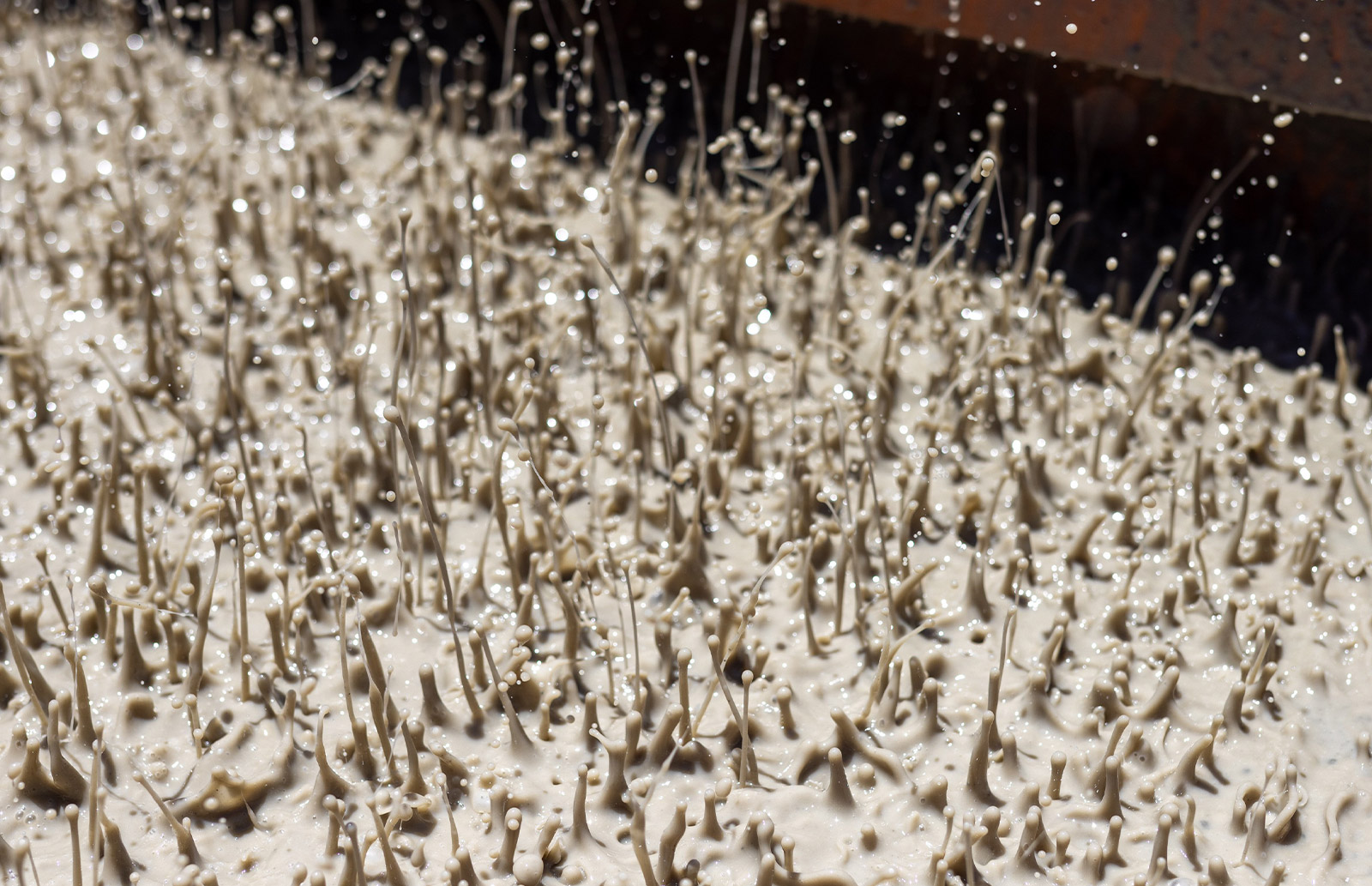
‘Ctrol’ is a biodegradable product approved within Australia and used at Australian Federal and State Government operations, although international regulations would need to be checked. A licensed Customs Broker may be able to provide more local-focused advice and assistance.
Alternatively, Curtin University’s DARC – the chemists and manufacturers of Ctrol led by Professor Masood Mostofi may be able to provide additional insight. (Curtin University is a respected Australian tertiary institution and is also considered one of the country’s leading technology colleges).
